
VP8
37c3317fd058; modified for Encode Wiki · CC BY-SA 4.0VP8 is a video format created by On2 Technologies and announced in 2008. Google bought On2 in 2010 and released VP8 that year as an open, royalty-free codec, together with the WebM container and the libvpx encoder and decoder. It was designed to compete with H.264, and it is the ancestor of VP9 and AV1. Lossy WebP images are VP8 intra frames in a RIFF container.
When to use VP8
Section titled “When to use VP8”- WebRTC. Browsers must implement VP8 and H.264 Constrained Baseline (RFC 7742), so VP8 is the safe common codec for realtime video.
- Old WebM players and pipelines that only accept VP8.
For anything else, use VP9 or AV1: both are much more efficient, and VP9 plays in every current browser.
Format summary
Section titled “Format summary”| Property | VP8 |
|---|---|
| Samples | 8-bit YUV 4:2:0 only, progressive only (no interlacing) |
| Picture size | Up to 16383×16383 (14-bit width and height fields) |
| Frames | Keyframes and interframes; no B-frames |
| Profiles | Versions 1–3 replace the six-tap motion interpolation with bilinear or full-pixel filters for low-power decoders; virtually all streams use version 0 |
| Containers | WebM/Matroska (V_VP8), IVF, RTP (RFC 7741) |
| HDR, 10-bit | Not supported; tone-map HDR sources to SDR before encoding |
There is no lossless VP8 mode; WebP’s lossless mode is a separate format. Alpha in WebM VP8 is carried as a second VP8 stream in Matroska BlockAdditional data, which browsers support but many other players ignore.
Coding tools
Section titled “Coding tools”VP8’s design is close to H.264 Baseline with some ideas of its own:
- 16×16 macroblocks (8×8 for each chroma plane), with 4×4 subblocks.
- Intra prediction: DC, vertical, horizontal and TrueMotion (TM_PRED) for 16×16 luma and 8×8 chroma; ten modes for 4×4 luma blocks. TrueMotion predicts each pixel as left + above − above-left.
- Three reference frames: the last frame, a golden frame (an older frame kept as a long-term reference, e.g. for a static background), and an alternate reference (alt-ref) frame, which is decoded but never shown. Encoders build alt-ref frames from future source frames, often temporally filtered, which recovers much of the benefit of B-frames without reordering.
- Motion: quarter-pel luma vectors with six-tap interpolation;
SPLITMVlets a macroblock carry up to 16 motion vectors. - Transforms: a 4×4 DCT, plus a Walsh–Hadamard transform over the 16 luma DC coefficients in 16×16-predicted macroblocks.
- Quantisation: a 0–127 quantiser index with per-component adjustments, and up to four segments per frame with their own quantiser and loop-filter level.
- Entropy coding: a boolean arithmetic coder. Probabilities are fixed within a frame and can be updated per frame, which is simpler than H.264’s CABAC and helps error recovery.
- Token partitions: coefficient data can be split into 1, 2, 4 or 8 partitions by macroblock row, so decoders can run multiple threads.
- In-loop deblocking with “normal” and “simple” filters, adjustable per segment and per reference/mode, and skipped on internal edges of macroblocks that have no coefficients and don’t use 4×4 prediction or split motion.
History and reception
Section titled “History and reception”VP8 launched with bold efficiency claims that early tests did not bear out. Moscow State University’s comparison, for example, showed libvpx well behind x264:
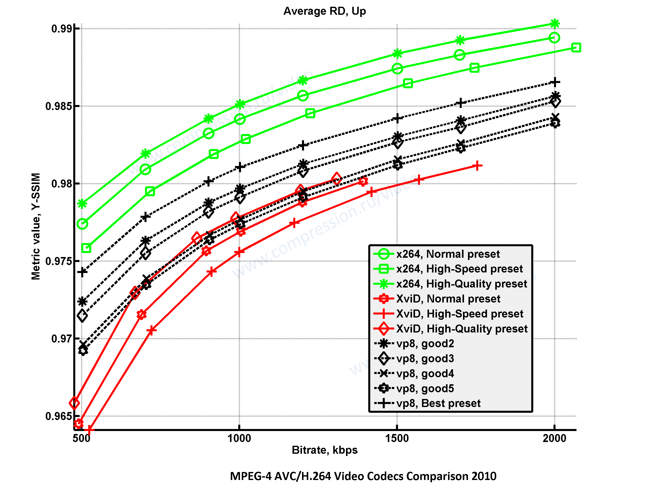
Fiona Glaser, an x264 developer and co-author of FFmpeg’s fast native VP8 decoder, wrote an influential analysis at launch. She liked parts of the design, including TrueMotion prediction and the simple arithmetic coding, but criticised the slow loop filter, parts of the transform design, and above all the specification: the “bitstream guide” was incomplete and libvpx’s behaviour differed from it. That problem was never fully fixed. When the format was published as RFC 6386 in November 2011, it stated that the bitstream is defined by the reference decoder source code, and the text yields to the code where they conflict.
Later royalty-free formats learned from this: AV1 was developed with a written specification and conformance streams alongside the reference code. VP8 also set a precedent for web video by dropping interlacing entirely.
Encoders and decoders
Section titled “Encoders and decoders”| Relationship | Project or format | Evidence and scope | Status |
|---|---|---|---|
| Implements by | libvpx / vpxenc v1.17.0 | libvpx v1.17.0 provides VP8 encoding and decoding.Scope: Encoder Decoder · Sources: libvpx v1.17.0 source | Documented |
libvpx is the only encoder in practical use (vpxenc, or libvpx in FFmpeg). Decoding is cheap: FFmpeg’s native vp8 decoder and libvpx both run fast in software, and some Intel, NVIDIA and mobile SoCs also decode VP8 in hardware.
A VP8 WebM with FFmpeg:
ffmpeg -i input.mkv -c:v libvpx -crf 10 -b:v 1M -c:a libopus output.webmFor VP8, -crf (libvpx’s cq-level, 0–63, lower is better) works as constrained quality: the encoder aims for that quality with -b:v as the bitrate ceiling. Always set both: without -b:v, FFmpeg falls back to a 256 kbit/s target, and that cap rather than -crf decides the quality. Choose -b:v for your resolution and content. See vpxenc for realtime settings.
Licensing
Section titled “Licensing”VP8 is royalty-free; Google licenses its patents under the WebM project’s patent grant and libvpx is BSD-licensed. In 2013 Google and MPEG LA reached an agreement licensing VP8-related patents from a group of H.264 patent holders, which ended MPEG LA’s effort to form a VP8 patent pool.